
Emotional Resilience
The Emotional Resilience lens measures an individual’s ability to remain effective under pressure. It focuses on the traits that influence how people respond to challenge, regulate their emotions, and sustain a constructive mindset in the face of uncertainty.
Resilience is not simply about “pushing through” — it’s about staying flexible, emotionally grounded, and confident enough to take action. This lens offers a structured view of those underlying capacities and provides practical feedback to support growth.
How This Lens Fits Into the Five Lens Framework
The Enneagram gives us insight into behavioural patterns, but not how people respond when those patterns are disrupted by stress. Emotional Resilience fills that gap by assessing how well someone can adapt, recover, and maintain clarity when under strain.
This lens adds a vital dimension to the Five Lens model by revealing how inner stability influences outward behaviour. It’s especially important when coaching for leadership development, change readiness, or performance under pressure.
How It Supports Coaching & Organisational Development
Emotional Resilience plays a central role in personal and professional effectiveness. In coaching, it enables practitioners to assess how well a client can stay grounded and act with intention under stress — and where they might benefit from reframing or skill-building.
In organisations, this lens supports resilience-building strategies, helps identify risk of burnout or reactivity, and provides practical data for leadership development, wellbeing programmes, and change management initiatives.
Core Components of Resilience
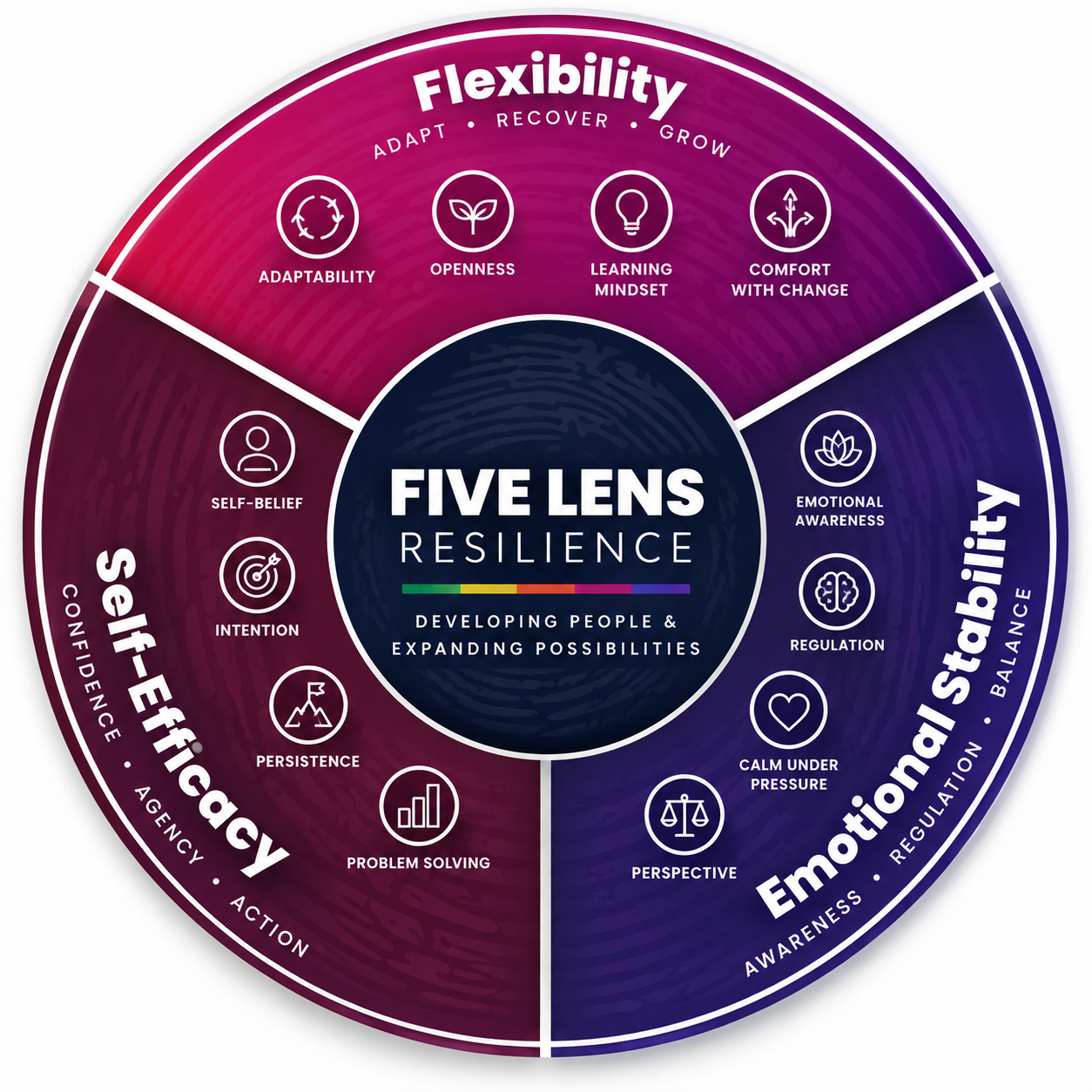
Within the FIVE LENS model, Emotional Resilience is characterized by three foundational pillars that can be actively developed and strengthened over time:
Flexibility (Mental)
A mental-intellectual attribute that relates to cognitive adaptability and optimism. It represents the ability to remain open to new possibilities, reframe challenges, and apply critical thinking to overcome difficulties rather than becoming rigid.
Emotional Stability (Affective)
An internal emotional state that is grounded and not easily swayed by external chaos. It enables individuals to act rationally, soothe their nervous system, and maintain a calm presence even in high-pressure situations.
Self-Efficacy (Motivational)
A directional-motivational aspect measuring deep-seated self-confidence. It predicts an individual's willingness to take on complex challenges, learn new skills, and persistently drive toward goals despite setbacks.
The Resilience Cycle
Resilience is not merely the ability to "bounce back" to the status quo; it is the capacity to integrate difficult experiences and emerge stronger. The FIVE LENS model measures how effectively individuals navigate the three stages of the resilience cycle:
How an individual absorbs the initial impact of a stressor. High resilience in this stage involves recognizing the emotional toll without being completely overwhelmed or immediately resorting to destructive Enneagram defense mechanisms.
The process of finding equilibrium. This involves emotional regulation, seeking appropriate support, and using cognitive flexibility to assess the reality of the situation rather than catastrophizing.
Translating the experience into learning. High resilience culminates in self-efficacy, where the individual uses the adversity to build new capabilities and approach future challenges with increased confidence.