The Enneagram
Where self-awareness begins in the Five Lens model.
The Enneagram reveals the internal forces that drive how people respond, collaborate, and lead. By assessing personal triggers, defence mechanisms, and core strengths, this lens creates a nuanced map of each individual’s behavioural landscape. Rather than assigning a fixed "type", the Enneagram shows how patterns shift under stress and in different contexts. This insight empowers practitioners to strengthen self-awareness, boost emotional intelligence, and foster healthier, more effective working relationships.
Why the Enneagram Is Our Core Lens
At Five Lens, the Enneagram is the starting point because it delivers instant insight. It reveals what drives behaviour, where blind spots lie, and how individuals relate to others under pressure or in trust. But we don’t treat it as a static label.
Our approach recognises that people move fluidly between styles depending on stress, context, and intention. Rather than assigning a single style, we measure how often each of the nine styles shows up, making it possible to reflect how people adapt and shift in real-world settings.
This gives individuals a shared language for growth and gives coaches and leaders a powerful first step toward meaningful transformation.
“It gives clients a mirror, not a label. And that’s where transformation begins.”
The Enneagram Styles
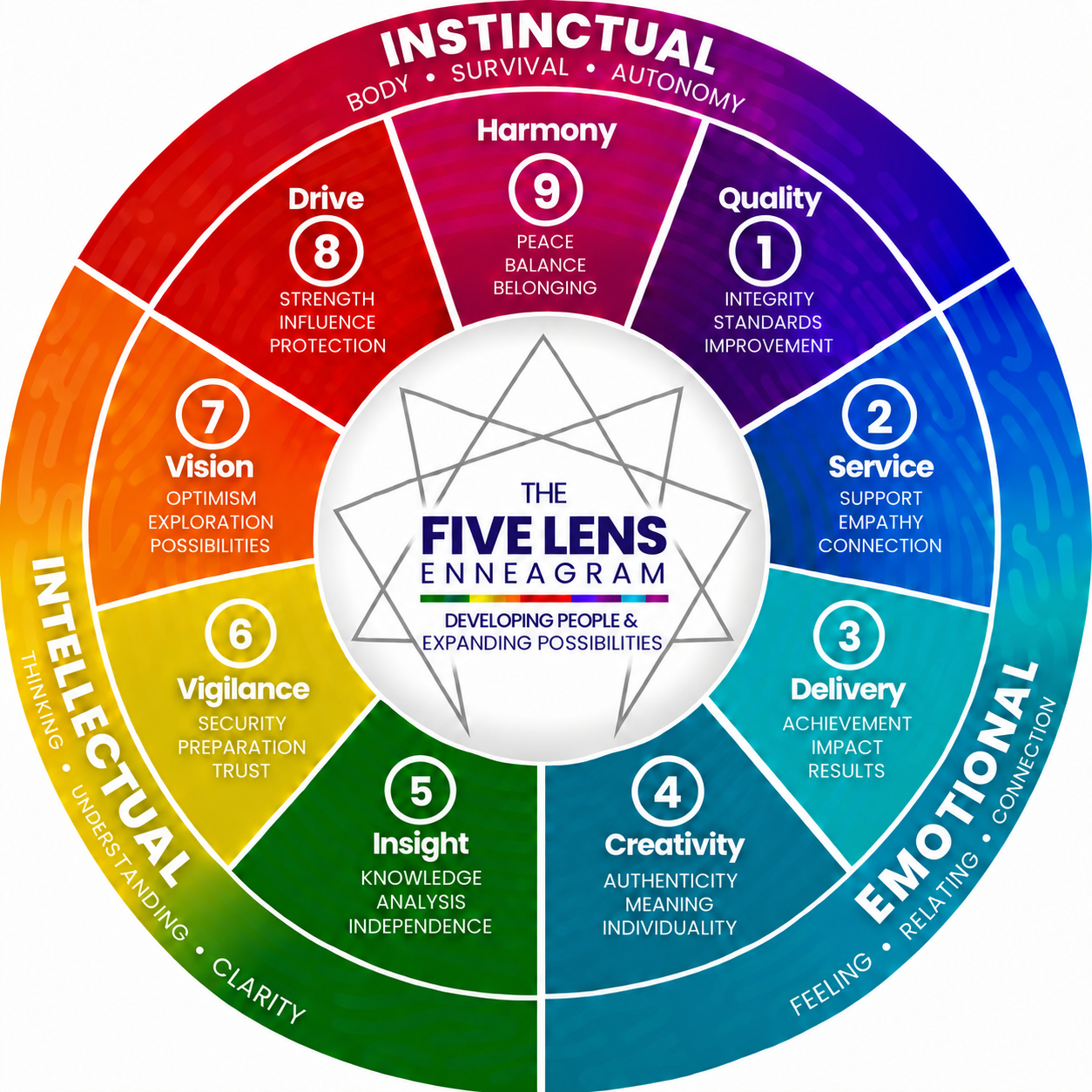
Each Enneagram style reflects a unique behavioural pattern and motivational driver. Here’s an overview of how each Enneagram style typically operates in a work or leadership context:
The Pursuit of Quality
Avoids: Criticism and being perceived as ineffective or wrong.
Strives to: Deliver perfection and uphold the highest standards.
Focuses on: Doing things the "right way" and maintaining integrity.
Service and Support
Avoids: Addressing their own needs directly.
Strives to: Be helpful, supportive, and generous.
Focuses on: The needs and wellbeing of others.
Achievement & Results
Avoids: Failure and appearing unsuccessful.
Strives to: Achieve success and be seen as competent.
Focuses on: Maintaining a successful image finding efficient paths to results.
Creativity & Meaning
Avoids: The ordinary, superficial, or routine.
Strives to: Be unique, authentic, and emotionally deep.
Focuses on: Expressing individuality and finding deeper meaning in experiences.
Knowledge & Insight
Avoids: Feeling incompetent or overwhelmed socially or intellectually.
Strives to: Be objective, knowledgeable, and self-sufficient.
Focuses on: Acquiring information and maintaining personal boundaries.
Vigilance & Security
Avoids: Risk, danger, and being caught off guard.
Strives to: Be prepared and secure.
Focuses on: Identifying potential risks and ensuring contingency plans are in place.
Optimism & Vision
Avoids: Pain, negativity, and restrictive situations.
Strives to: Stay positive, optimistic, and open to new experiences.
Focuses on: Exploring options, future opportunities, and maintaining flexibility.
Strength & Drive
Avoids: Vulnerability and loss of control.
Strives to: Be strong, assertive, and in control of their environment.
Focuses on: Protecting themselves and others, often confronting challenges head-on.
Harmony & Stability
Avoids: Conflict and disconnection from others.
Strives to: Maintain peace, harmony, and stability in relationships.
Focuses on: Creating calm environments and avoiding difficult confrontations.
Evidence at a Glance: The Enneagram’s Value — and Its Limits
The Enneagram has become a trusted tool for professional development across sectors — from coaching practices to global corporations.
Research shows that Enneagram insights can help improve team dynamics, emotional intelligence, and self-awareness, and in some studies, it has rivalled or outperformed other models in predicting workplace attitudes.
But like any model, it’s not without limits. On its own, the Enneagram can oversimplify, especially if it’s used to define people by a single style. It doesn’t account for how individuals respond to stress, what deeper needs drive behaviour, or how multiple intelligences influence decision-making.
As one peer-reviewed review noted, real behavioural change requires more than insight — it requires structured development.
How Five Lens Extends the Model
The Five Lens framework builds on the strengths of the Enneagram while solving for its gaps.
Where the Enneagram helps map current behaviour, our additional four lenses — Personal Mastery, Emotional Resilience, Social Drives, and Energy Centres — bring in the emotional, motivational, and contextual dimensions that drive meaningful change.